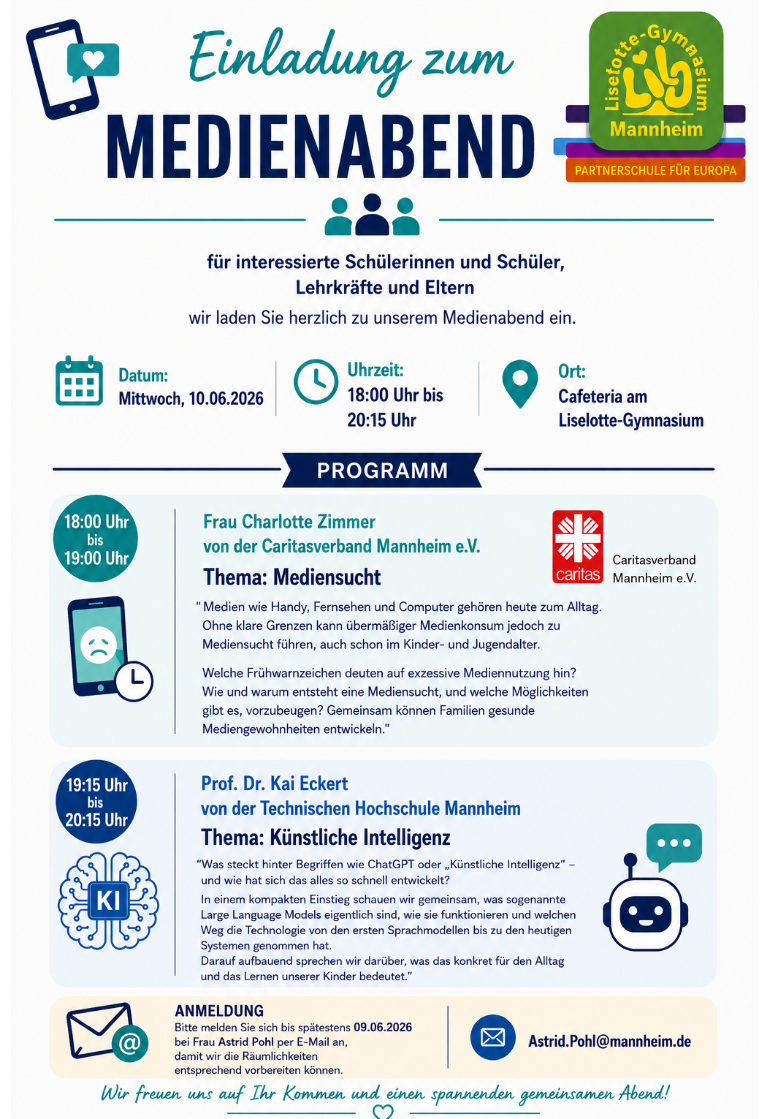
On June 10, 2026, Kai Eckert will give a talk at the Liselotte-Gymnasium Mannheim as part of their Medienabend (Media Evening) — an event organized for students, teachers, and parents interested in the role of digital media in young people’s lives.
The evening features two presentations. The first, by Charlotte Zimmer from the Caritasverband Mannheim e.V., addresses the topic of media addiction, its warning signs, and how families can develop healthier media habits together.
The talk second talk, delivered by Kai Eckert, offers a compact introduction to how Large Language Models (LLMs) actually work — starting from the basics of probabilistic language modeling and N-gram models, through neural networks, RNNs, attention mechanisms, and the Transformer architecture, all the way to modern agentic AI systems.
Beyond the technical foundations, the talk addressed the practical and societal implications of AI for schools and everyday life:
- How children are already using AI — from getting homework done to vibe coding video games and asking for story ideas.
- Strengths and limitations of language models — results can be surprisingly good, but also confidently wrong, and context matters enormously.
- How to use AI productively in learning — as a feedback tool, a brainstorming partner, or a Socratic dialogue system, while preserving one’s own cognitive engagement.
- Critical media literacy — understanding not just how these systems work, but who is behind them and what their business incentives are. Platforms like Google, Meta, and Microsoft are aggressively integrating AI into established products, often in ways that reduce rather than support digital self-determination.
A Note on AI and Schools
One of the central arguments of the talk is that schools — and parents — need to engage seriously with both the technology and its context. Children use AI as a matter of course, often without understanding the difference between a search engine result and a generated answer. At the same time, AI has genuine potential to support individualized learning and to make feedback more accessible.
The challenge is to build the kind of media competence that allows students to use these tools reflectively rather than dependently — and to recognize that understanding why you are doing a task matters just as much as completing it.