
Mental health matters just as much as physical health — and academia is no exception. Kai Eckert has completed the MHFA Ersthelfer course and is now certified as a Mental Health First Aider.
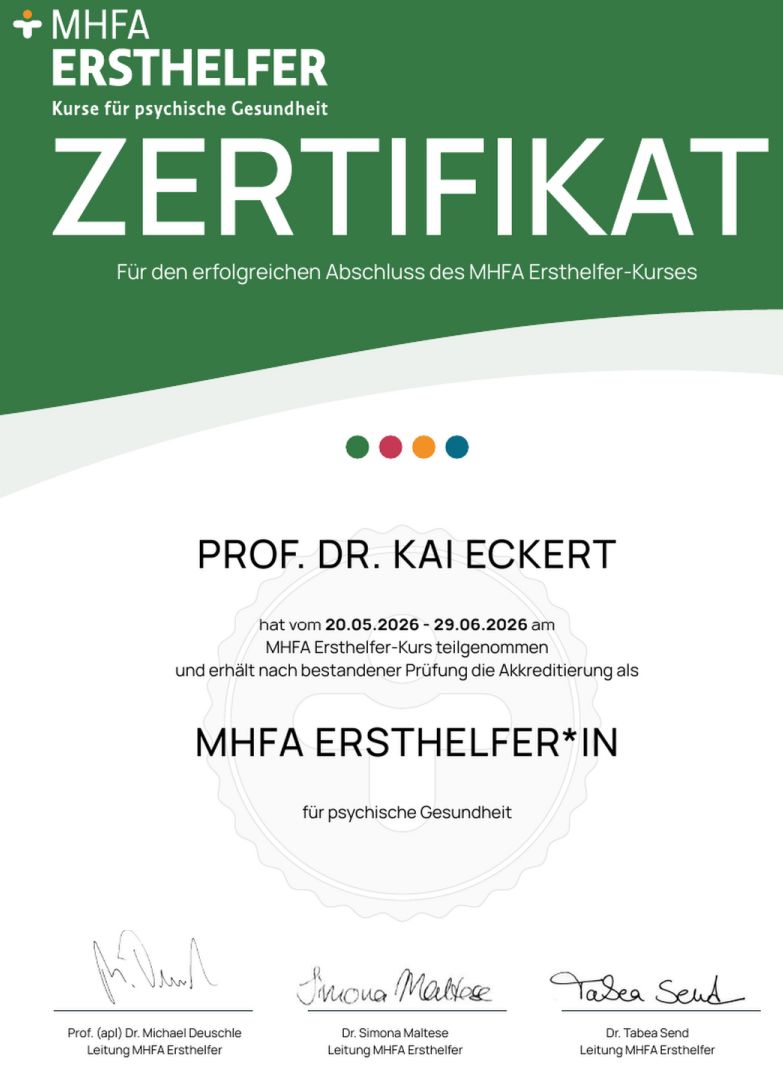
The certificate, awarded after the course and the final exam
Everyday work in teaching and research means being in contact with a lot of people — students, colleagues, fellow researchers — and many of them are under considerable stress, pressure and uncertainty. We talk a great deal about academic performance and research outcomes. The signs that someone is struggling with their mental health are much less obvious, and they are easy to miss precisely when it matters most.
What MHFA is
Mental Health First Aid is an evidence-based programme that teaches laypeople how to respond to mental health problems and crises — the same idea as a first aid course for physical emergencies, applied to psychological health. It originated in Australia and is now taught in numerous countries; the German version, MHFA Ersthelfer, is run by the Zentralinstitut für Seelische Gesundheit here in Mannheim, with a course of twelve hours for adults helping adults.
The training covers how to
- identify early warning signs of mental distress and mental illness,
- approach someone with empathy and without judgement,
- offer initial support and guide the person towards professional help.
Being able to provide a safe environment and early support can make a real difference. None of this turns anyone into a therapist — that is not the point. The point is to know what to do in the moments before professional help is involved, instead of hoping that someone else will notice.
A recommendation
The course is worth the time for anyone working in higher education, in leadership roles, or in team-oriented environments. Thanks go to course instructor Alexander Noyon — himself a professor at the Faculty of Social Work of Mannheim Technical University — for an insightful, practical and genuinely meaningful course.