
The streaming platform Twitch has become an important social environment where players and viewers interact in real time, form communities, and develop shared norms. At the same time, these communities can be affected by harmful behavior, including harassment, abusive language, and discrimination.
In their paper, accepted at the 2026 IEEE Conference on Games (CoG) in Madrid, Ronja Fuchs (University of Hannover), Florian Rupp (Mannheim Technical University), Timo Bertram (Johannes Kepler University Linz), Kai Eckert (Mannheim Technical University), and Alexander Dockhorn (University of Southern Denmark) present a large-scale analysis of approximately 20 million Twitch chat messages, investigating how toxic behavior differs across game genres and their communities. The results show that toxicity varies significantly not only between game genres, but also between individual games within the same genre, suggesting that game-specific community norms and mechanics may play an important role in shaping toxic behavior.
The study, titled “Toxicity in Twitch Chats: An LLM-Based Analysis Across Gaming Communities”, will be presented at CoG 2026, which takes place from 1 to 4 September at the Complutense University of Madrid. It introduces a Large Language Model-based (LLM) zero-shot classification approach for analyzing Twitch chat messages while incorporating a context window of preceding messages to better capture the meaning and context of individual messages. The approach enables a fast and more fine-grained analysis of different forms of toxicity based on a taxonomy and was validated through both human–model agreement and evaluation against an existing labeled dataset of toxic messages.
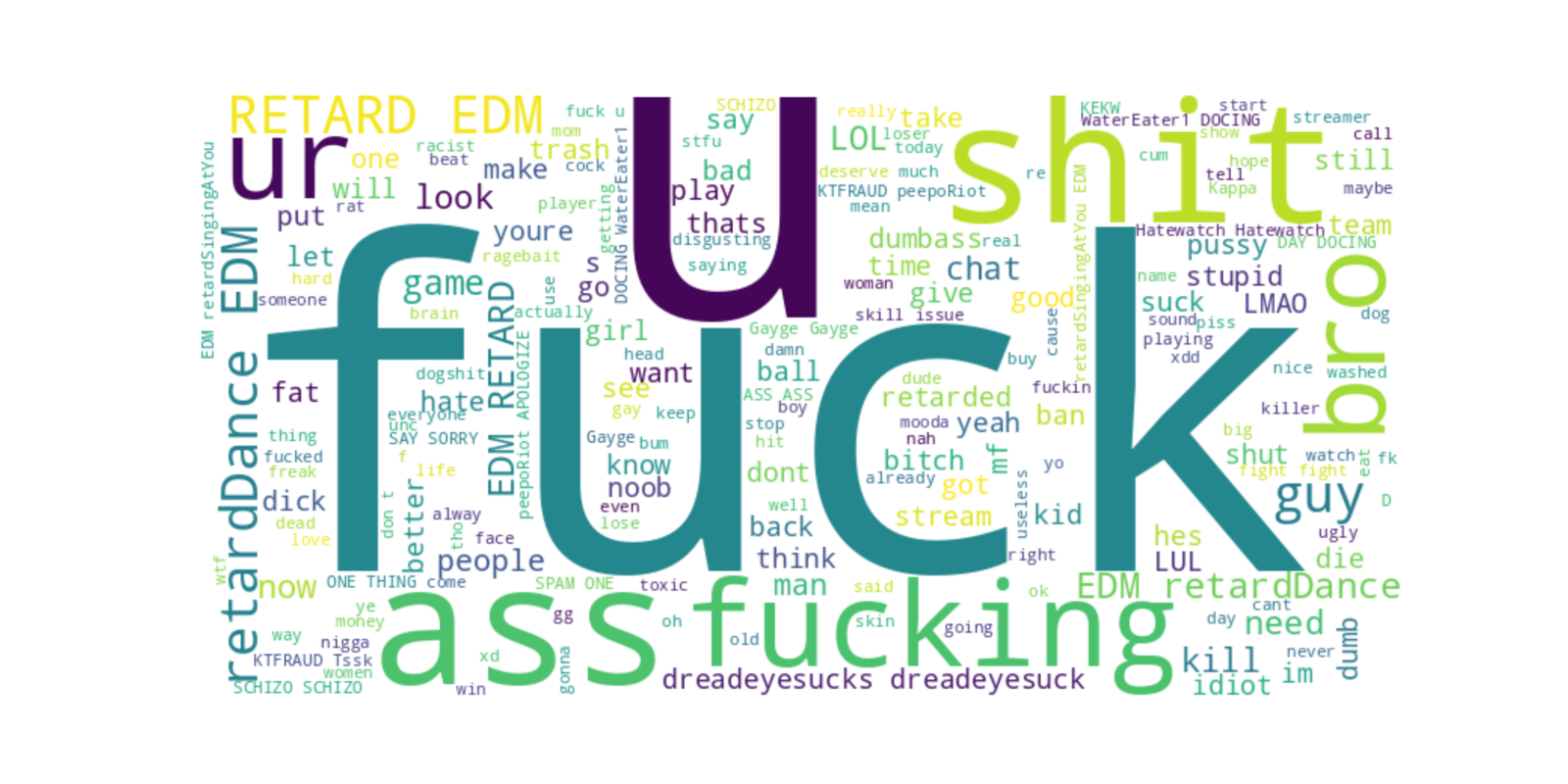
The most frequent terms across the messages classified as toxic. Content warning: explicit language, slurs and insults.
Overall, 2.4% of analyzed messages were classified as toxic, with harassment being the most prevalent form of toxicity, frequently accompanied by profanity. While overall toxicity levels are relatively similar across games, the distribution of different types of toxic behavior varies significantly, with Valorant and Counter-Strike 2 being a notable exception. Genre also influences both the overall level and composition of toxicity: MOBA games showed the highest rate at 3.2%, while sports games had the lowest at 2.0%. At the individual-game level, the differences were even more pronounced, ranging from 4.0% for Red Dead Redemption 2 to 0.7% for Minecraft. Overall, the findings suggest a common underlying pattern of harassment and profanity across gaming communities, while much of the finer-grained variation appears to be driven by the specific dynamics and norms of individual games and their communities rather than genre alone.