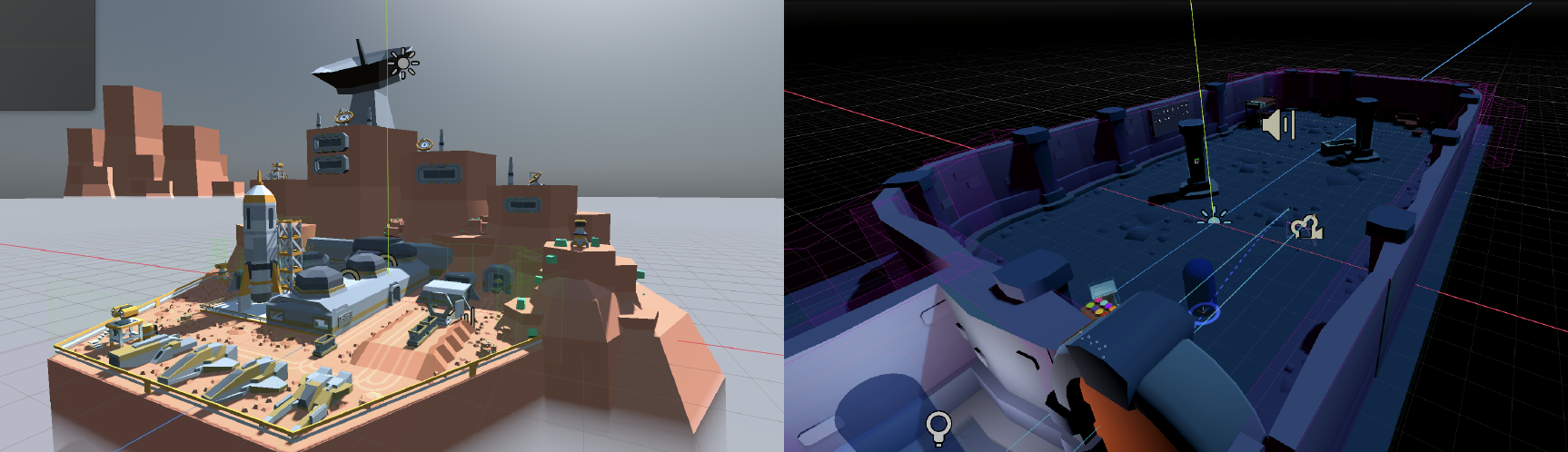
The course “Immersive Worlds — VR and Stage” (Virtual Reality Project, VRP, Winter Term 2025/26), co-created by JAVASCRIPT PROTECTED and Prof. Dr. Kai Eckert, asked students to develop and prototype concepts for Extended Reality technologies. The approach combined two dimensions: physical interaction and staging, explored through theatre techniques, and visual VR implementation using the free and open source Godot game engine.
As a narrative foundation, students drew on a crime novel by Mannheim author Alexander Hartung, who also participated in hand-on sessions and gave valuable insights into narrative design. A visit to SandboxVR Mannheim gave students first-hand experience with professional, multi-user VR systems and directly informed several of the projects.
A full-day hands-on workshop on using Godot for VR was conducted by industry experts Jonas Hundertmark and Matthias Jaenicke to provide our students with the required technical skills.
Student Projects
Dead End Maze
Alina Petek, Sebastian Stinner, Yannick Alsleben
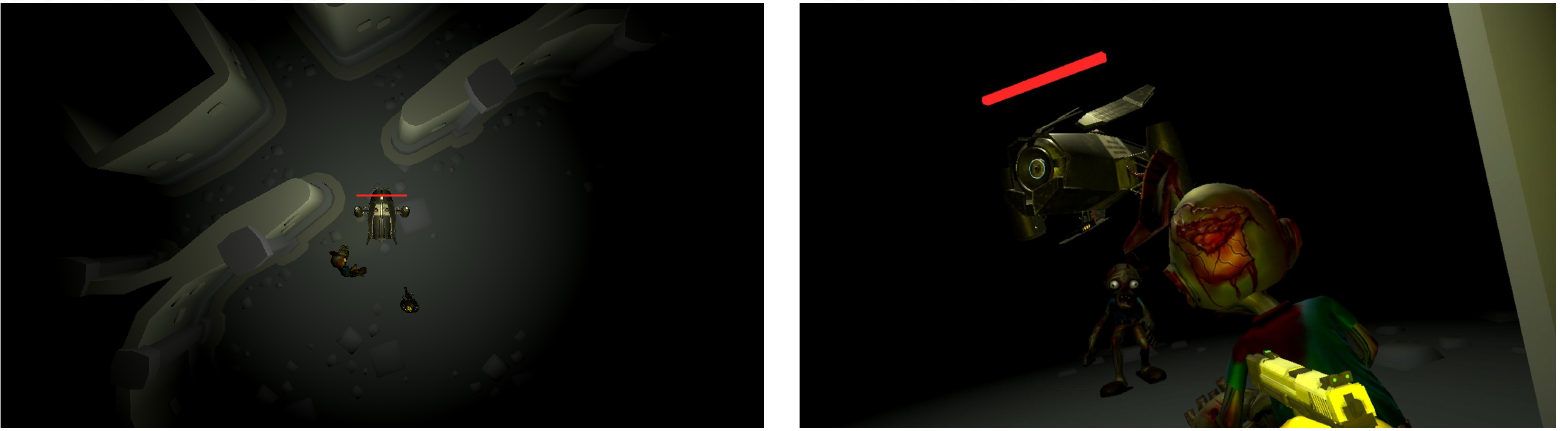
A cooperative game that bridges two fundamentally different display modes. One player navigates a dark labyrinth in full VR first-person; the other controls a drone from a 2D top-down view on a standard PC. Neither can succeed alone — the VR player has a weapon but no light, the PC player has visibility but no defence. The core idea is that the asymmetry between flat-screen and immersive VR is not a limitation to work around, but the mechanic itself.
Paradox VR
Tobias Heid, Kai Sellmann, Laurent Derguti, Josef Peskin, Daniel Lehmann, Pietro Orazio
A cooperative VR escape room in which two players share the same physical space but inhabit entirely different virtual worlds. Clues needed in one world are only visible in the other, making communication the primary mechanic. Because each player’s environment is independently authored, the concept opens the door to tailored experiences — two players could, for example, tackle the same puzzle session through entirely different themes or difficulty levels, making it a practical model for accommodating mixed groups such as families with children of different ages.
Years Apart
Selim Eser, Daniel Zdravkovic, Lukas Kirgios
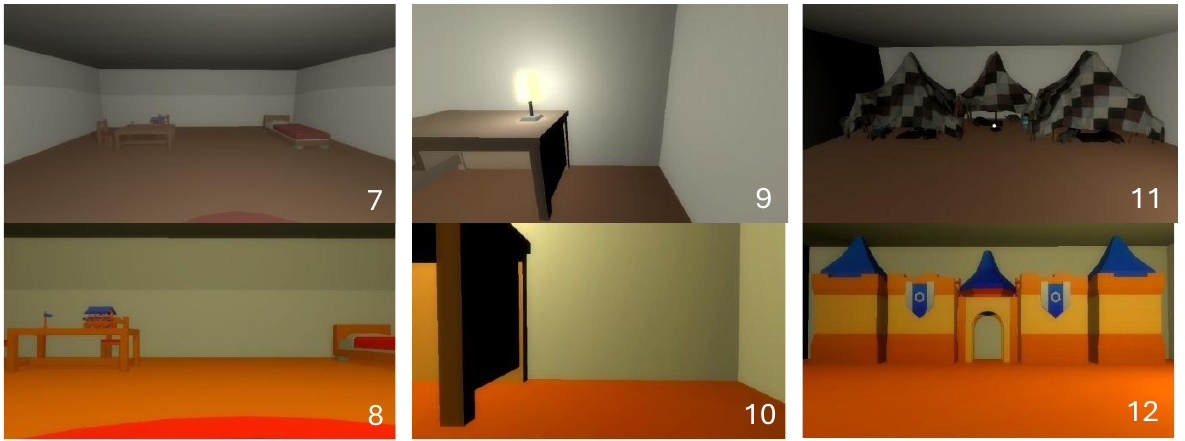
A single-player VR puzzle game in which the player switches between two biological ages — infant and teenager — using a pocket watch. Each state changes height, reach, field of view, and even the readability of objects in the environment. While the experience is solo, the design logic mirrors multiplayer perspective-splitting: no single viewpoint contains the full picture, and progress requires actively combining what both ages perceive. The team’s argument is that this only works in VR, where the physical difference between the two states is genuinely felt rather than merely seen. The picture below shows the different perspectives for the adult (top) and the child (bottom), where for example a pillow fort turns into an actual castle.